
To ensure your family’s safe trip to Aruba, complete 3 mandatory steps: fill out the online ED Card up to 7 days before departure, verify passport validity for your stay duration, and pack reef-safe sunscreen (SPF 50+) as oxybenzone products are banned. Aruba requires no tourist visa for US/Canada/EU citizens staying under 30 days and has no mandatory vaccinations for travelers from North America or Europe.
What Are the Entry and Document Requirements for Families?
Every family member needs a valid passport for the stay duration and a completed online ED Card (fillable 7 days before travel). US/Canada/EU citizens don’t need a visa for stays under 30 days. Children traveling with one parent require a notarized consent letter from the absent parent including contact info, travel dates, and ID copy.
Check Passport Validity and Travel Documents
Your passport must be valid for the duration of your stay in Aruba. Keep organized:
- a valid passport for every traveler,
- a completed Embarkation and Disembarkation (ED) card,
- proof of a return or onward ticket.
Do You Need a Tourist Visa for Aruba?
Citizens of the following countries do not require a tourist visa for stays of up to 30 days:
- 🇺🇸 United States,
- 🇨🇦 Canada,
- 🇬🇧 United Kingdom,
- European Union member states.
Verify requirements for family members with passports from other nations.
| Region/Country | Visa Requirement | Max Stay (Standard) |
|---|---|---|
| USA & Canada | No | 30 Days |
| European Union | No | 30 Days |
| Caribbean (Select Islands) | No | 30 Days |
What Are the Requirements for Parental Consent for Child Travel?
If a child travels with only one parent, you must carry a notarized letter of consent from the absent parent. This documentation should include:
- the absent parent’s contact information,
- authorization for the child to travel to Aruba,
- specific dates of travel,
- a copy of the absent parent’s ID.
Should You Enroll in the Smart Traveler Enrollment Program (STEP)?
For U.S. citizens, enrolling in the Smart Traveler Enrollment Program (STEP) is recommended. This free service registers your trip with the nearest U.S. Embassy and provides:
- important information from the Embassy about safety conditions in Aruba,
- assistance in contacting you during emergencies (natural disasters, civil unrest, or family emergencies),
- help for family and friends to reach you in urgent situations.
Complete the Online ED Card (Embarkation/Disembarkation)
The Online ED Card is mandatory for all visitors, including children. Complete this digital form up to 7 days before your flight. Once approved, print or save the confirmation email to present at airport check-in and upon arrival.
What Vaccinations and Health Precautions Are Necessary?
Aruba requires no mandatory vaccinations for travelers from North America or Europe. Ensure routine immunizations (MMR, DTP, Varicella, Polio, flu shot) are current. Yellow Fever vaccination is required only if arriving from endemic countries in South America or Africa.
Are There Mandatory Vaccinations for Aruba?
There are no mandatory vaccinations required for entry into Aruba for travelers arriving from North America or Europe. The island is free of many diseases common in other tropical regions.
Recommended Routine Vaccinations for Children and Adults
Ensure all family members are current on routine immunizations. The CDC recommends:
- Measles-Mumps-Rubella (MMR) vaccine,
- Diphtheria-Tetanus-Pertussis vaccine,
- Varicella (Chickenpox) vaccine,
- Polio vaccine,
- yearly flu shot.
Is Yellow Fever Vaccination Required?
The Yellow Fever vaccination is required only if you are arriving from a country where Yellow Fever is endemic (certain parts of South America or Africa). Not required for direct flights from US, Canada, or Europe.
How to Manage Prescription Medication and Medicine Import Control
Pack enough prescription medication for the entire trip plus extra for delays. Always keep medicines in their original, labeled containers to avoid customs issues.
Key tips for medication management:
- carry a copy of your doctor’s prescription,
- pack medications in your carry-on luggage to prevent loss,
- ensure liquid medications comply with TSA liquids rules or have a medical exemption declared at security.
Consulting a Tropical Medicine Specialist Before Travel
For families with compromised immune systems, pregnancy, or complex health histories, consult a travel medicine specialist 4-6 weeks before departure for personalized advice on food and water safety.
How to Ensure Environmental Health and Sun Safety
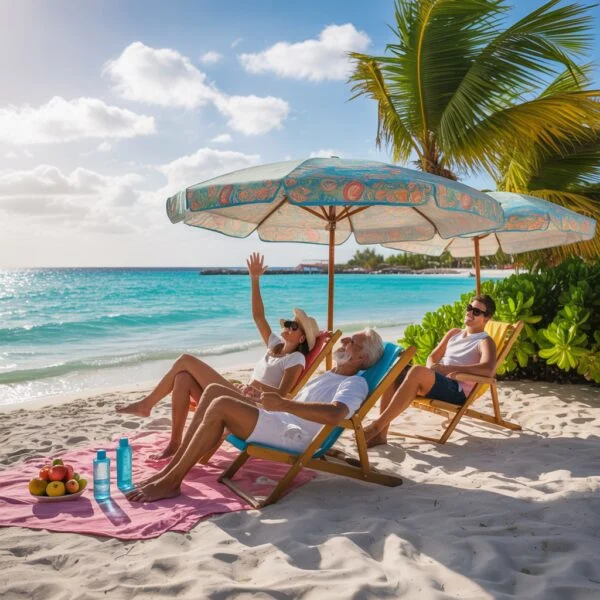
Apply reef-safe sunscreen (SPF 50+) every 2 hours—Aruba bans oxybenzone products. Drink water constantly to prevent dehydration in the desert-like climate. Use DEET or Picaridin insect repellent during rainy season (October-January) to prevent Zika and Dengue.
Preventing Heat Stroke and Dehydration in Tropical Climates
Aruba’s desert-like climate with constant trade winds can mask heat. Drink plenty of water throughout the day, even if you do not feel thirsty. Signs of heat exhaustion in children include:
- excessive thirst,
- fatigue or weakness,
- headache and dizziness,
- cool, moist skin with goosebumps when in the heat.
Effective Sun Protection Strategies for Children
The UV index in Aruba is very high. Apply broad-spectrum, water-resistant sunscreen with SPF of at least 30 (preferably 50 for kids). Aruba has banned sunscreens containing oxybenzone to protect coral reefs—pack “reef-safe” biodegradable sunscreen.
Apply sunscreen 15 minutes before going outside and reapply every 2 hours, or immediately after swimming or sweating. Dress children in UV-protective clothing and wide-brimmed hats.
Insect Repellent Use and Preventing Mosquito-Borne Illnesses
Mosquitoes can be present during rainy season (October-January) or in sheltered areas. Use insect repellent containing DEET, Picaridin, or oil of lemon eucalyptus.
Apply repellent to exposed skin and clothing, but avoid applying it to the hands of young children who might put them in their mouths.
Understanding Risks of Zika and Dengue Fever
Mosquito-borne diseases like Zika and Dengue Fever are present in the Caribbean. Pregnant women or couples planning pregnancy should consult their doctor before booking. Prevent bites by wearing long sleeves and pants during early morning and late afternoon when mosquito activity is highest.
What Are the Standards for Food and Water Safety?
Aruba’s tap water is completely safe to drink—produced through WHO-standard desalination. Restaurants adhere to strict hygiene codes. Wash hands before eating and ensure street food is served hot to prevent foodborne illness.
Is Tap Water Safe to Drink in Aruba?
Yes, Aruba’s tap water is completely safe to drink. The island produces water through a saltwater desalination plant, resulting in pure, high-quality water meeting WHO standards. Bring a reusable bottle and refill from the tap.
Food Safety Tips for Dining Out and Street Food
Aruba adheres to strict hygiene codes—dining out is generally safe. When enjoying street food or beach snacks, ensure food is served piping hot. Avoid food sitting at room temperature for extended periods.
Preventing Foodborne Illnesses During Your Vacation
To minimize stomach issues:
- wash hands thoroughly before eating,
- wash fruits and vegetables with tap water (which is safe),
- be cautious with dairy products if they have not been refrigerated properly.
How to Maintain Water Safety During Activities
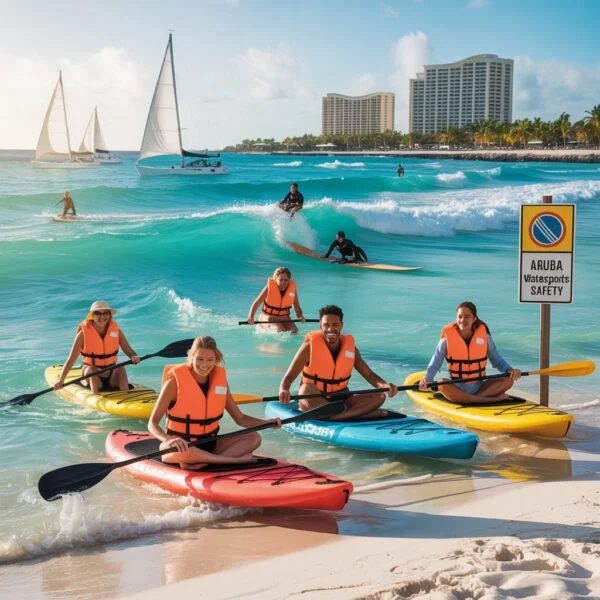
Swim only on South and West coasts (Palm Beach, Eagle Beach) with calm waters. North coast has dangerous undercurrents—swimming prohibited. Use U.S. Coast Guard-approved life jackets for children, not inflatable armbands. Wear water shoes to avoid sea urchin spines in rocky areas.
Ocean Safety and Awareness of Strong Currents
Water conditions vary by location. South and West coasts (Palm Beach, Eagle Beach) have calm waters ideal for swimming. North coast (Boca Grandi, Arikok National Park) features rough seas and very strong undercurrents—swimming is dangerous and often prohibited.
Supervising Children Near Pools and Beaches
Designate a “water watcher” among adults whose sole responsibility is watching children without distractions. For young children or weak swimmers, use U.S. Coast Guard-approved life jackets rather than inflatable armbands, which are not safety devices.
Marine Life Awareness and Safety Precautions
Minor injuries can occur:
- Coral: do not touch or stand on coral; it can cause cuts and infection (and damages the reef),
- Sea Urchins: wear water shoes when exploring rocky areas to avoid stepping on spines,
- Jellyfish: while uncommon, be aware of your surroundings. If stung, seek lifeguard assistance immediately.
Handling Medical Emergencies in Aruba
Dial 911 for emergencies. Dr. Horacio Oduber Hospital (+297 527 4000) offers 24-hour emergency care near Eagle Beach. Purchase travel health insurance with medical evacuation coverage (domestic plans don’t cover overseas treatment). Medical evacuation costs exceed $50,000 without insurance.
Where to Find Medical Care Facilities and Hospitals
The main hospital is Dr. Horacio Oduber Hospital, located near Eagle Beach, with a 24-hour emergency department. Several private “Urgent Care” clinics and medical centers (like Imsan in San Nicolas) handle non-life-threatening issues.
How to Access Emergency Services and Embassy Contact
In life-threatening emergencies, dial:
| Service | Phone Number |
|---|---|
| Police / Fire / Ambulance | 911 |
| Police Station (Non-Emergency) | 100 |
| Hospital (Dr. Horacio Oduber) | +297 527 4000 |
Keep your country’s consulate or embassy contact information handy. For U.S. citizens, the Consulate General is in Curacao, with a consular agency in Aruba.
Is Health Insurance Overseas Necessary for Families?
Most domestic health insurance plans do not provide coverage outside your home country. Purchase comprehensive travel health insurance covering medical expenses, hospitalization, and doctors’ visits in Aruba.
Understanding Medical Evacuation Insurance Coverage
For serious medical conditions requiring treatment elsewhere, medical evacuation can cost upwards of $50,000. Ensure your travel insurance policy specifically includes medical evacuation coverage.
Locating Pharmacies and Medical Supplies
Pharmacies (“Boticas”) are well-stocked with over-the-counter medications. They may not carry exact brand names—know the generic name of needed medications. At least one pharmacy operates 24/7 on a rotating schedule.
Transportation and Road Safety Tips
Official taxis have “TX” license plates and use government-fixed rates (confirm price before entering). You need a valid foreign driver’s license to rent a car (minimum age 21-23). Traffic in roundabouts has right of way. Right turns on red are prohibited unless signed otherwise.
What to Know About Traffic Safety and Road Conditions
Roads are generally in good condition, but signage can be sparse in rural areas. When it rains, roads become slippery due to water, oil, and dust mixture. Drive with caution during tropical showers.
Using Registered Taxis and Public Transportation Safely
Taxis have fixed rates set by the government based on destination—confirm price with the driver before getting in. Official taxis have “TX” on their license plate. Arubus public bus system is safe, reliable, and affordable for travel between hotels and downtown Oranjestad.
Requirements for International Driving Permits and Car Rentals
To rent a car, you typically need to be at least 21 or 23 years old. A valid foreign driver’s license is usually accepted; an International Driving Permit is not required for most tourists unless your license is in a non-Roman script.
Navigating Roundabouts and Local Traffic Rules
Traffic already in the roundabout has the right of way. Right turns on red are generally prohibited unless a sign indicates otherwise. Traffic drives on the right-hand side of the road, same as in the US.
General Safety and Crime Prevention for Families
Never leave valuables visible in rental cars. Use hotel safes for passports, cash, and electronics. Cover up when leaving the beach—walking in swimwear through shops or downtown is frowned upon. Report crimes immediately to Tourist Police and file a police report for insurance claims.
Preventing Petty Theft and Securing Cash and Valuables
Petty theft, such as snatching bags or stealing items from unlocked cars, can occur:
- never leave valuables visible in your rental car,
- use the hotel room safe for passports, extra cash, and electronics,
- do not leave bags unattended on the beach while swimming.
Avoiding Public Displays of Affection and Respecting Local Customs
Aruba is welcoming and diverse, but observe local customs. While beachwear is appropriate for the sand, cover up when entering shops, restaurants, or walking in town. Walking around supermarkets or downtown in just a bikini or swim trunks is frowned upon.
Safety Precautions for Nighttime Activities
Stick to well-lit, populated areas at night. The hotel strip and downtown areas are lively and safe, but avoid walking alone on dark beaches or in isolated areas after sunset. Keep an eye on your drinks and stay together as a group when exploring nightlife.
Reporting Crimes and Contacting Local Authorities
If you are a victim of a crime, report it immediately to local police and hotel management. A dedicated Tourist Police force is trained to assist visitors. Filing a police report is often required for insurance claims regarding stolen property.